Nomadic, discreet and easy to use, tablets and their phable cousins are the best allies of betting enthusiasts.
Indeed, thanks to the applications and mobile versions of online betting sites, you can now place bets and manage your account without staying behind your computer. There are great list online with the best UK mobile apps for betting> and give review to those apps.
Tablets and phablets have proven to be practical alternatives to laptops. More and more powerful and efficient, they can be used to bet, in addition to your computer. To bet from your iPad or Android tablet, you will simply need an Internet connection: it is the one that opens the door to online bookmakers.
There are two ways to bet from a tablet or a phantom:
go directly to your favorite site from your Internet browser,
or download an application.
Going through the download will guarantee you a better gaming experience if your phonebook has a smaller screen, or if you simply want to bet from your smartphone. Otherwise, downloading an application is not necessarily necessary. This is even impossible in some cases, since no operator offers an application designed for Windows Mobile or Windows RT.
If you have a Microsoft Surface tablet, a Lenovo Yoga 11 or 13, the Asus Vivo Tab RT or the HP Envy, the only way to bet online is to go directly to the site of your choice. Anyway, with their large screen and removable keyboards, they are hybrid devices, between tablets and laptops and ultra-light.
In terms of screen size and resolution, the Acer Iconia Tab A700, Asus Transformer Pad, Samsung's Galaxy Pro range and Google's Nexus 10 also play in the big league. If, on the other hand, you have a small tablet in the Archos 80, Nexus 7 or Galaxy Tab Lite style, we recommend that you download a betting application.
The iPad, on the other hand, is clearly the star tablet on horse and sports betting sites, and you will have no trouble finding an online betting application.
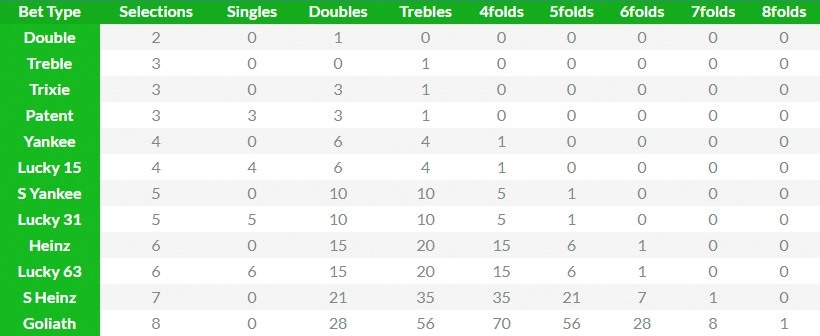
For example, played four games, you can choose to play 3/4 in your system. This means that you must have at least three real out of your four selected matches before winning. You can also guard yourself against accidents and choose to play 2/4 where you only need two real matches on the coupon. Common to all odds and system bets, however, is that the more you guard against losses, the more your coupon costs.
You can also guard yourself against accidents and choose to play 2/4 where you only need two real matches on the coupon. Common to all odds and system bets, however, is that the more you guard against losses, the more your coupon costs.
How do I know what the coupon costs?
To understand the calculation of the price, it is important to understand what forms the price. With a regular coupon without system bets you can play for example. 100 $ coupon. But when you make a system game, you actually make multiple coupons at once, and so the effort has to be multiplied by the number of coupons in the system. With a 3/4 system with a stake of $ 100, you are essentially playing four different coupons with three matches on each - combined on one system coupon. Namely, it takes four different combinations of triples to cover the 3/4 system, and the bet is therefore 4 x 100 $. See the table for number of rows and prices per betting system:
System
Number of combinations / rows
My number right for gain
Price per combination
Total price
Recommended min. odds in average per match*
Maximum profit **
2/3
3 - doubles
2
100 $
300 $
1/75
918 $
2/4
6 - doubles
2
100 $
600 $
2/50
3750 $
3/4
4 - tripler
3
100 $
400 $
1/60
1920 $
2/5
10 - doubles
2
100 $
1000 $
3/20
6400 $
3/5
10 - tripler
3
100 $
1000 $
2/20
10,650 $
4/5
5 - quadruplets
4
100 $
500 $
1/50
2530 $
2/6
15 - doubles
2
100 $
1500 $
3/90
$ 22,815
3/6
20 - tripler
3
100 $
2000 $
2/75
$ 41,600
4/6
15 - quadruplets
4
100 $
1500 $
2/00
24,000 $
5/6
6 - females
5
100 $
600 $
1/45
3840 $
2/7
21 - doubles
2
100 $
2100 $
4/60
44/436 $
3/7
35 - triples
3
100 $
3500 $
3/30
125/755 $
4/7
35 - quadruplets
4
100 $
3500 $
2/45
$ 126,210
5/7
21 - females
5
100 $
2100 $
1/70
50,673 $
6/7
7 - sixteen
6
100 $
700 $
1/40
5264 $
* Recommended min. odds are set if you hit my number right so you approx. Have your total deposit returned, and thus do not suffer any loss.
System Games Strategy: - Choice of system games
When you need to make system games, it is important that you take it right. So it is no use to have odds on your system, which not least pulls your total deposit home, at the lowest profit.
At embedded-system.net we believe that there are two ways to approach it, and below you can read more about the thought process that you should do when placing a system game with a bookmaker.
1. Choose system based on your matches
Once you have found your matches and decided on which characters to put, then just take a look at the average bet and what the lowest paid line will give you. If you play 3/5, you take three lowest odds and multiply them. 2.20 x 2.00 x 2.40 = total odds 10.56. The system 3/5 has 10 rows, and the value of the odds at the lowest row / combination should therefore not be below 10.00. If it is lower, you have got the wrong system.
Tip: Make your bets and then find out which system is best for your odds choices!
2. Choose matches based on a particular system
Some players like individual systems best and have decided in advance which system to play. But as always, the value of the individual odds must fit the system. If you play 2/5, it does not matter that your matches have an average odds of 2.00 when you now know that my odds must be 3.20 on average not to make a deficit, even if you hit two right as the system requires it.
The advantage of choosing a system in advance is that you easily know which odds to look for, but are most suitable for the days when there is a large game offering.
Example of bad system play
In this system game, the player has not taken into account whether he will, at a minimum, get his money home if four matches go home. Thus, it is only row 4 that sends the player's total deposit back if he hits four matches.
The betting exchanges has taken the bookmaker market with great success over the past 10 years and has turned upside down on how serious players place their bets. In this article, we will explain to you everything you need to know about the still relatively new concept.
Is the bookmaker an extinct breed? . You can now choose to play against another person - so-called P2P. When you play on a betting exchange - also called a betting exchange - you are playing against other players, not a game provider. It's a bit like the mechanisms you know from a betting exchange where supply and demand dictate the price, and then there's just one platform that facilitates the trade. The platform - in this case the Betting Exchange - takes a small commission of all winning bets, but otherwise blends in with the odds on offer.
What betting exchanges can you play at?
A betting exchange requires a huge amount of liquidity (lots of customers and bets) to function as intended. Unfortunately, there is only one gaming exchange with a license; Playing Exchange. Fortunately, it is also the best betting market on the market, and the selection of real competitors is unfortunately overlooked. In the past we could use betting exchanges lie Parbet, BETDAQ (bought by Ladbrokes), Matchbook and , but the competition with the mighty has taken the lives of these operators. Today Betfair's Betting Exchange is the leading exchange platform.
An all-dominant market leader with great product
As mentioned, Gaming is by far the world's largest gaming exchange. It is estimated that the company has a market share of over 90% for betting exchanges. BETDAQ still has little revenue in primarily the UK, and it is estimated that they have a small 7% of the market. The Exchange was established in 1999 by the two Englishmen, Edward Wray and Andrew Black. Since then, the company has just grown and grown - and following the merger with Irish Paddy Power, the company is approaching a market capitalization of $ 60 billion. The company now has offices in several parts of the world, but the focus is still on the two offices in London and Malta respectively.
What are the Benefits of a Betting Exchange?
The most obvious advantage of a betting exchange is, of course, higher odds. The odds you find are consistently higher than with a traditional bookmaker. The odds may be up to 20% better than with a bookmaker, but it varies greatly depending on the specific market. Eg. you will surely be able to pick up higher odds on a Champions League match at , while there is not much scam to play on ice hockey or handball. The Commission at the Betting Exchange has gradually moved up to 6.5%, which of course erases pretty much the benefit. In 2015, the Commission was raised from 5% to 6.5% in the market, which in itself is a huge disappointment for us who love the concept.
New ways to bet
When you play on a betting exchange you suddenly have a lot of new ways to win. At a traditional bookmaker it's about finding "winners", while at a betting exchange it can also be about finding losers. You can choose to "sell" odds, which means you are betting against an outcome. If we take a typical 1X2 match, you will usually play on one of the outcomes of your bookmaker. You will thus lose the game if your outcome does not hit correctly. For example, at a gaming exchange you can. choose to sell the second in a match. That means you win on both home victory and a draw. It is a bit like a good old-fashioned half-guard. For some players it is easier to find "losers" than "winners" and for them a betting exchange is a revelation.
Winning games / long-term betting have also opened up new ways to make a profit. Let's take a World Cup final round as a concrete example. With a traditional bookmaker you will typically be able to bet on who wins the World Cup. It may be that a bookmaker gives you odds 5 of Brazil winning the World Cup, and these are more or less the options you have at that game. At a betting exchange you will be able to buy and sell odds on the winner of the World Cup tournament. Let's say that you didn't quite know your big favorite to win the tournament, then you can still play a game if, after all, you know who it won't be. "Belgium never wins the World Cup" is what you've come to expect - and they can be sold at odds 10 on Playing Exchange. This means that depending on the size of the counterpart's bet, the bet is liable for x 10. You now act as your very own bookmaker. You win at all World Cup winners other than Belgium - in return you get a bit of a hitch if Hazard & co succeeds. to take the title.
We bet on the outcome of an event, the winning tip must be correct.
Double
We bet on two events, and both tips must be correct
Triple or multiple bets
This is betting system with three or more tips for three or more events, and all must come in to win.
Exact result
The exact outcome of the sporting event must be predicted.
First goal
Here we guess which team or player will score the first goal.
The time of the first goal
The question here is exactly when to score the first goal of the match.
Double chance
For a football match, we bet on two out of three outcomes: 1X, 12, 2X
Goalscorer
The object of the bet is who will score the goal. This may be invalid if the player of your choice does not appear in the starting 11.
Odd / Even
The tip is whether the final result will be odd or even. A 0: 0 football match counts as even.
Half / Full Time Betting
The object of the bet is what will be the result at mid-term and at the end. Both bets must be correct for the win.
Mixed matches
These are virtual games (mixed game), the point being that the two teams play against each other, but not really against each other. Example: Arsenal play with Liverpool in the Premier League and Barcelona play with Real Madrid in the Spanish league. At this point, it appears that Arsenal Vs. Barcelona, but this game will not be played. The number of goals scored by both teams in regular play time (90 minutes, no overtime) is compared.
Over / under
Here you can guess that all points / goals will be above or below the given number. Examples:
Over / Under 2 Goals
The bet is that there will be fewer than two goals in the match. If one or fewer goals are scored in the match, then bets on the winner are below, bets are lost above. If two goals are scored, all bets will be void (which is why they often score 2.5). If the final score is 3 goals or more, then the winner is above and the winners are below.
Over / Under 2.25 Goals
This is a composite bet consisting of two bets: one bet over / under 2 goals and one bet over / under 2.5 goals. Example: If you bet $ 100 over / below the 2.25 goal, the bet will be split into two parts: a $ 50 bet over / under 2 and also $ 50 over / under 2.5 goals. If the end result is 1 goal or less, then the bets below are the wins and the loss is above. If there are 2 goals in the end, the bettors above will lose half of the bet, the other 50% will draw, half of those beting on below will win, half will bet. In the event of three or more goals, the losers below that win the winners.
Over / Under 2.5 Goals If the score is two or less, the winner will be the loser above. In case of three or more goals, the loser below and the loser above.